v0.1 · read-only · one Go binary

Your coding agents have
538 settings.
You have set 32.

agentconf scans ~/.claude, ~/.codex, ~/.cursor and ~/.gemini, then shows every setting you have set and every one you have not, explained, linked to the vendor docs, with cross-agent diagnostics. It never writes a byte.

$ curl -fsSL https://raw.githubusercontent.com/AviroopPaul/agentconf/main/install.sh | sh
or go install · brew · macOS and Linux, arm64 and amd64
🔒 127.0.0.1:4242
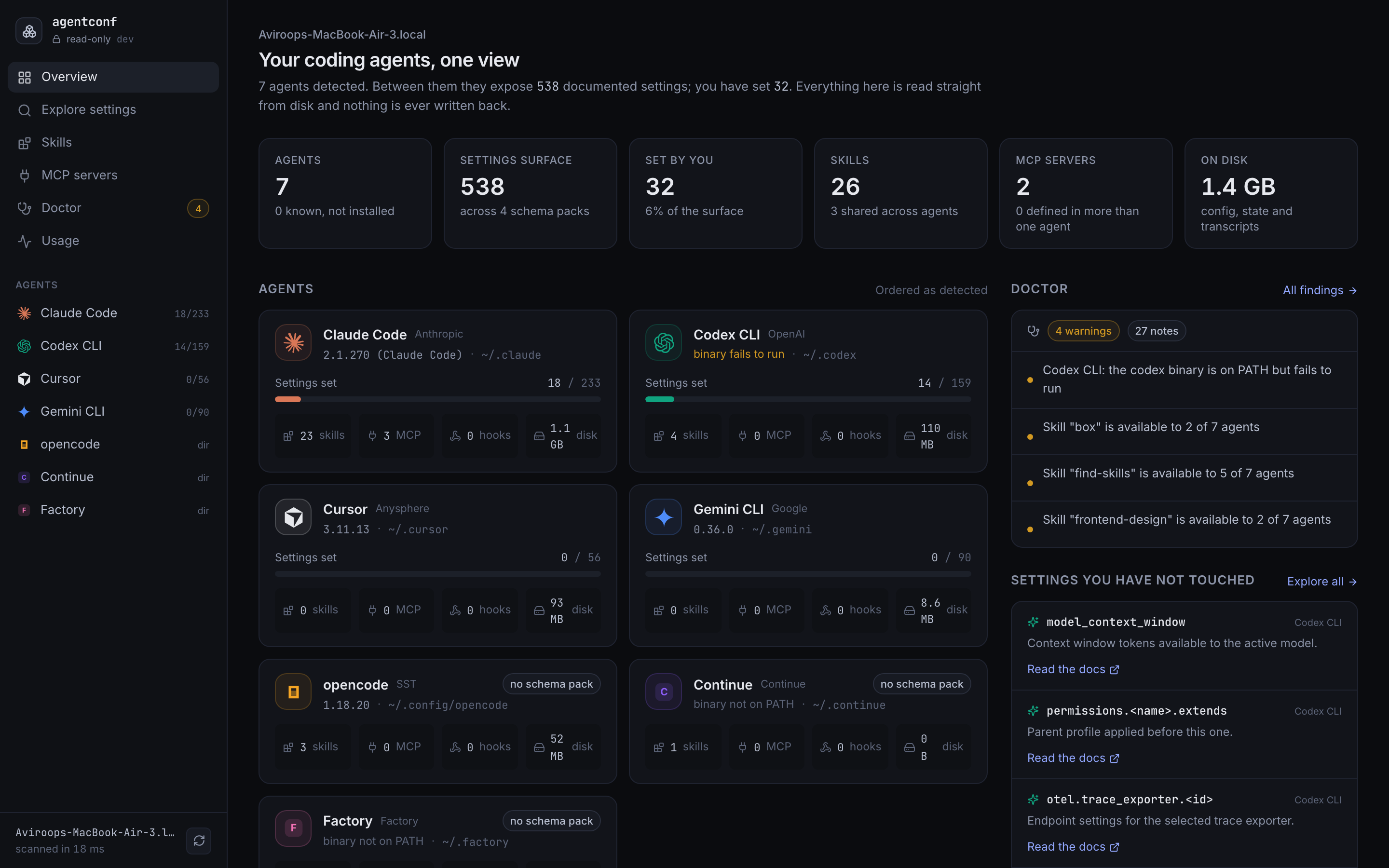
agentconf overview: seven agents detected, settings set versus available, doctor findings
Reads the config of
Claude Code Codex CLI Cursor Gemini CLI opencode + Continue, Factory, and any agent with a pack
The problem

The config is there. Nobody knows it exists.

Every coding agent keeps its knobs in a dotfolder. The vendors document hundreds of them: sandbox rules, effort levels, hooks, memory budgets, permission modes, MCP gating, statusline commands, plugin marketplaces. Almost none of it is discoverable from inside the agent. So people run on defaults, copy a settings.json from a blog post, and never look again.

233
documented keys in Claude Code's settings.json. The sandbox section alone has 38.
~/.claude/settings.json · 14 set on a heavy user's machine
45/ 58
lines of a real Codex config.toml were auto-generated trust_level entries. About five were choices.
~/.codex/config.toml · 159 documented keys and tables
4
different files and formats for the same MCP server. JSON at the repo root, TOML tables, JSON in .cursor, JSON in settings.json.
.mcp.json · config.toml · mcp.json · settings.json
agentconf doctor
$ agentconf doctor
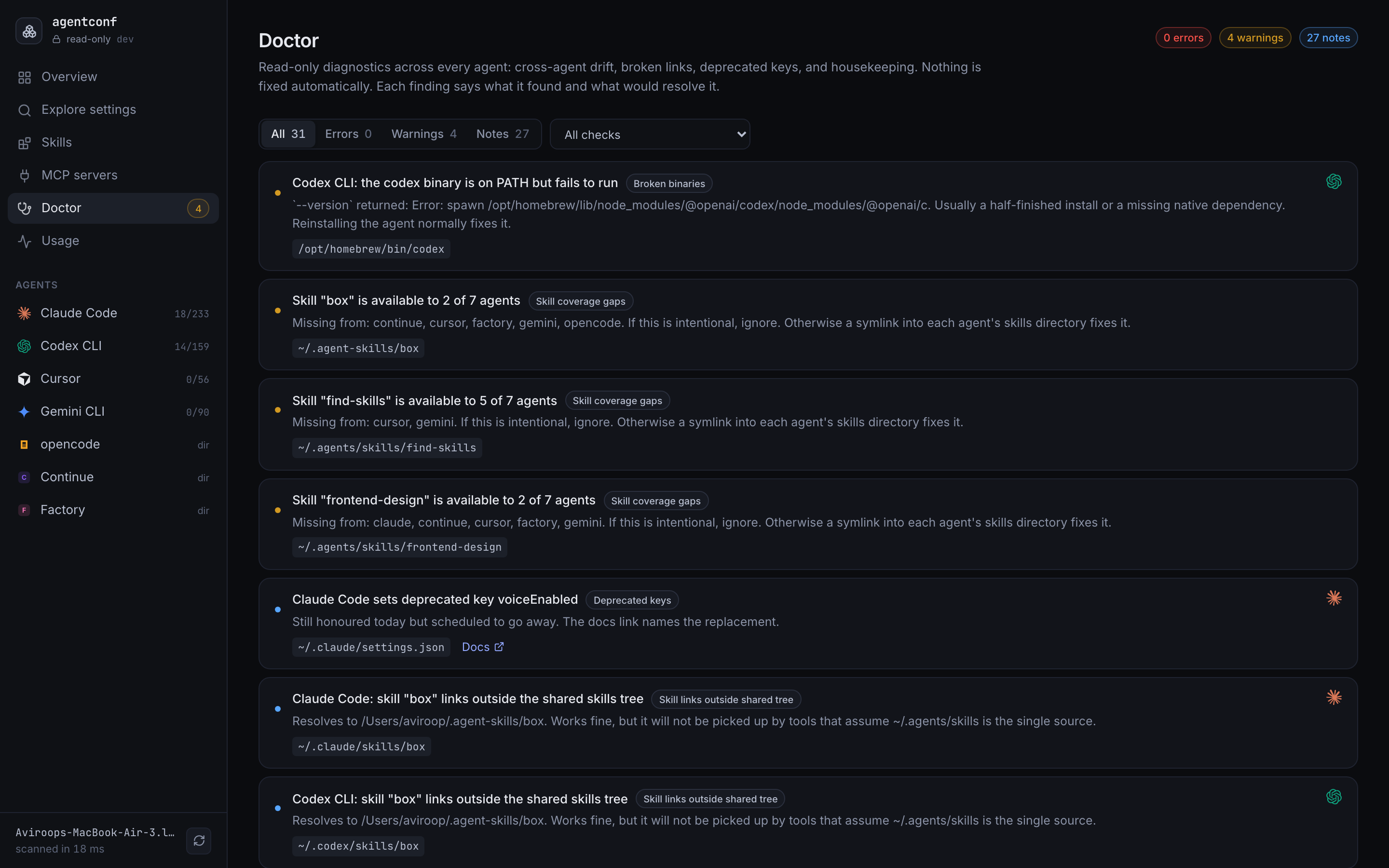
agentconf doctor: 7 agents, 0 errors, 4 warnings, 27 notes

[WARN] Codex CLI: the codex binary is on PATH but fails to run
       `--version` returned: Error: spawn .../codex-darwin-arm64/.../codex ENOENT. Usually a
       half-finished install or a missing native dependency.
[WARN] Skill "find-skills" is available to 5 of 7 agents
       Missing from: continue, factory. A symlink into each agent's skills directory fixes it.
[WARN] Skill "frontend-design" is available to 2 of 7 agents
[info] Claude Code sets deprecated key voiceEnabled
       Still honoured today but scheduled to go away. The docs link names the replacement.
[info] Global CLAUDE.md does not import AGENTS.md
       You run other agents that read AGENTS.md. A one-line @AGENTS.md keeps one source of truth.
[info] Skill "hyperframes" is available to 1 of 7 agents
... 22 more

Real output. The broken Codex install was news to the machine's owner.

What you get

Every setting, explained, with the docs one click away.

The UI knows nothing about individual keys. Everything it says comes from a schema pack: type, default, scope, a one-line summary, a longer note when the summary is not enough, and a deep link to the vendor's own page. New vendor setting on Tuesday, new pack on Tuesday.

Explore

Default view: what you have not touched

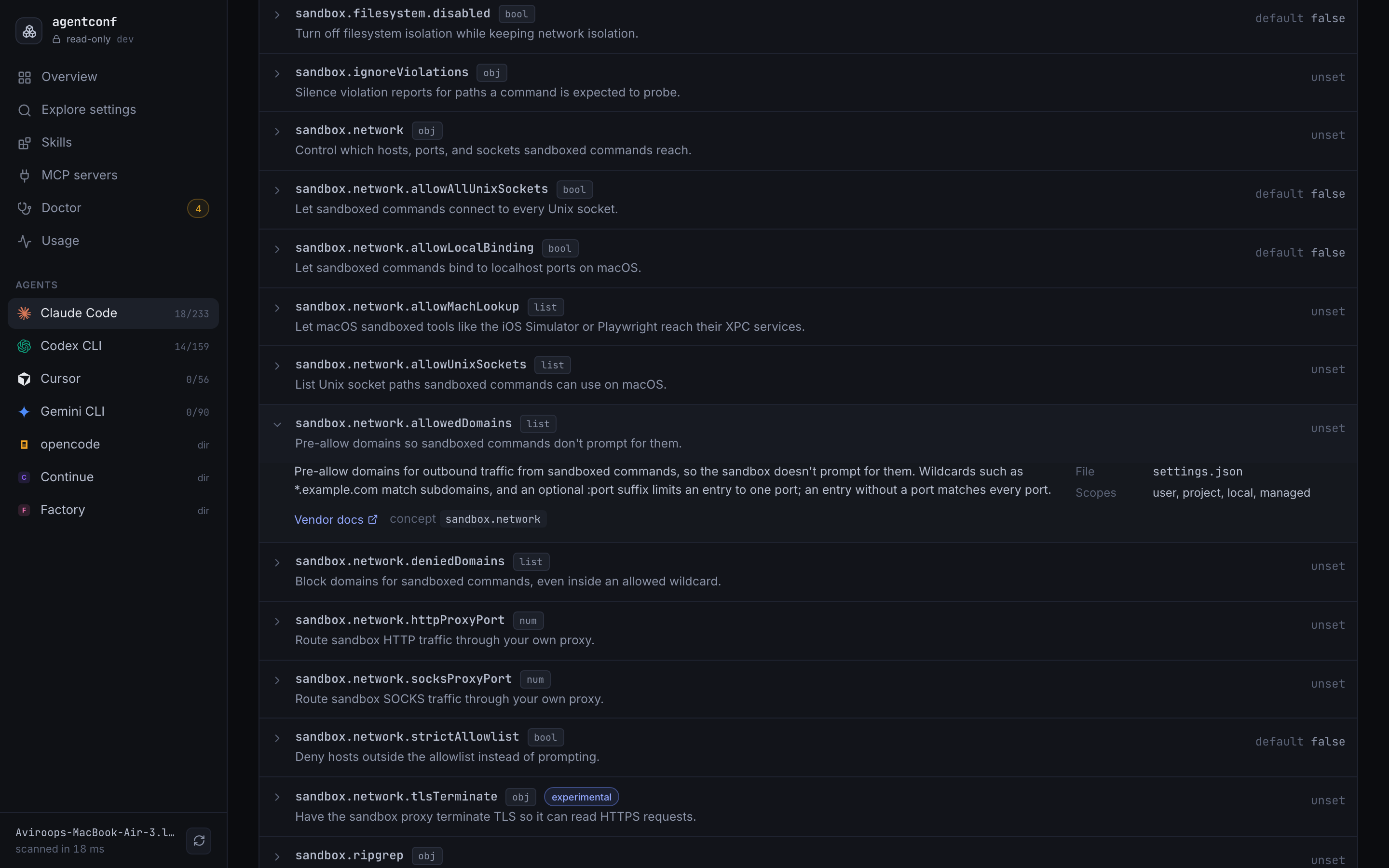
538 keys across four agents, grouped by category or by cross-agent concept, filtered to unset by default. Search hits key names, summaries and concepts. Enterprise-only keys are hidden until you ask.

  • Set vs. unset, per agent, at a glance
  • Experimental, deprecated and removed flags called out
  • Your current value, masked if it looks like a secret
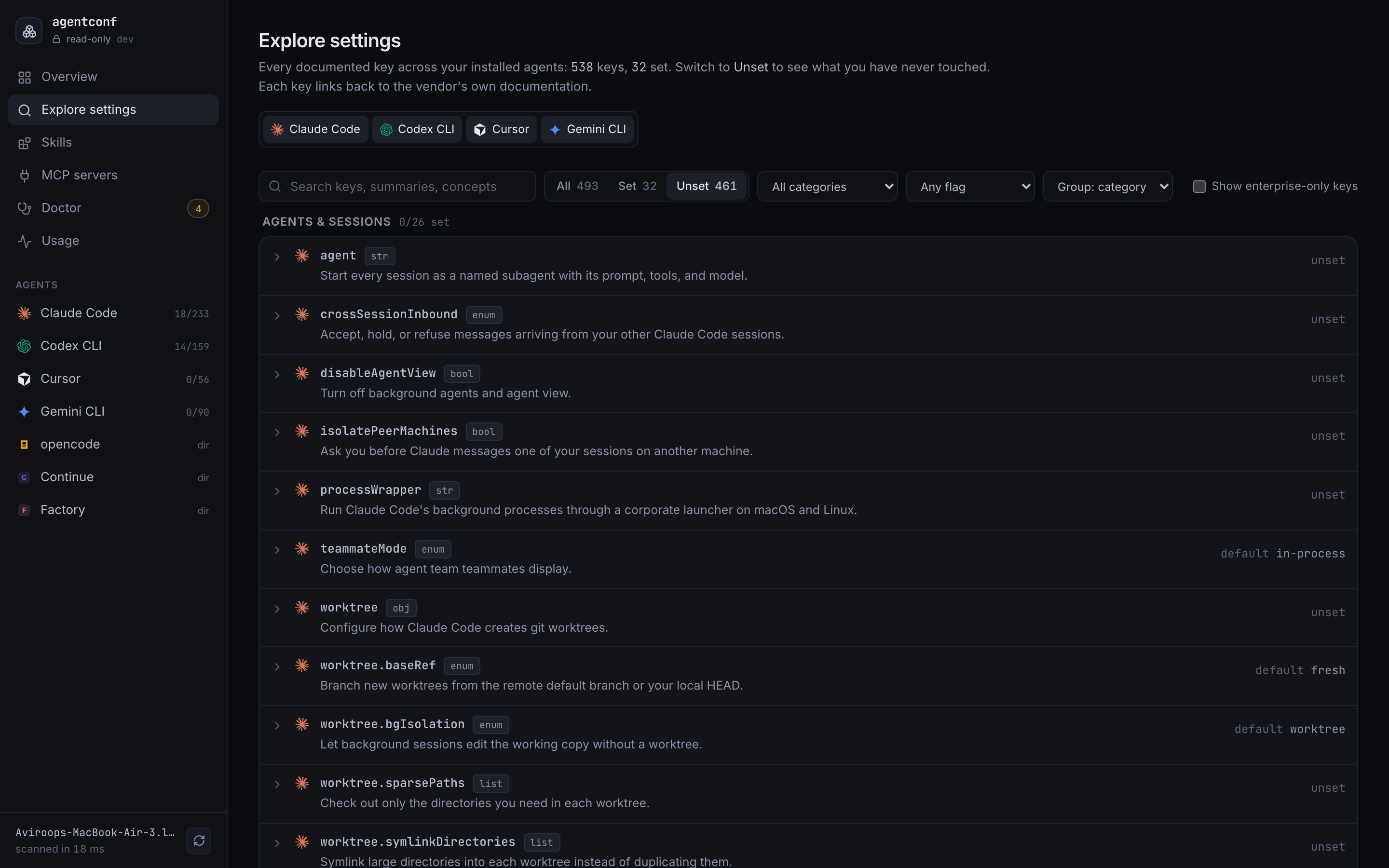
Explore: all settings across agents, filtered to unset
Agent

One page per agent, everything it reads

Settings by category, then every file and directory the agent looks at, whether or not it exists yet. State directories show size only. Credential files are marked and never opened.

  • Expand a key for the long note, allowed values, source file
  • Skills, MCP, hooks, plugins, rules, trusted projects
  • Instruction files, with AGENTS.md interop flagged
Agent page for Claude Code with a setting expanded
Skills

Which agent can see which skill

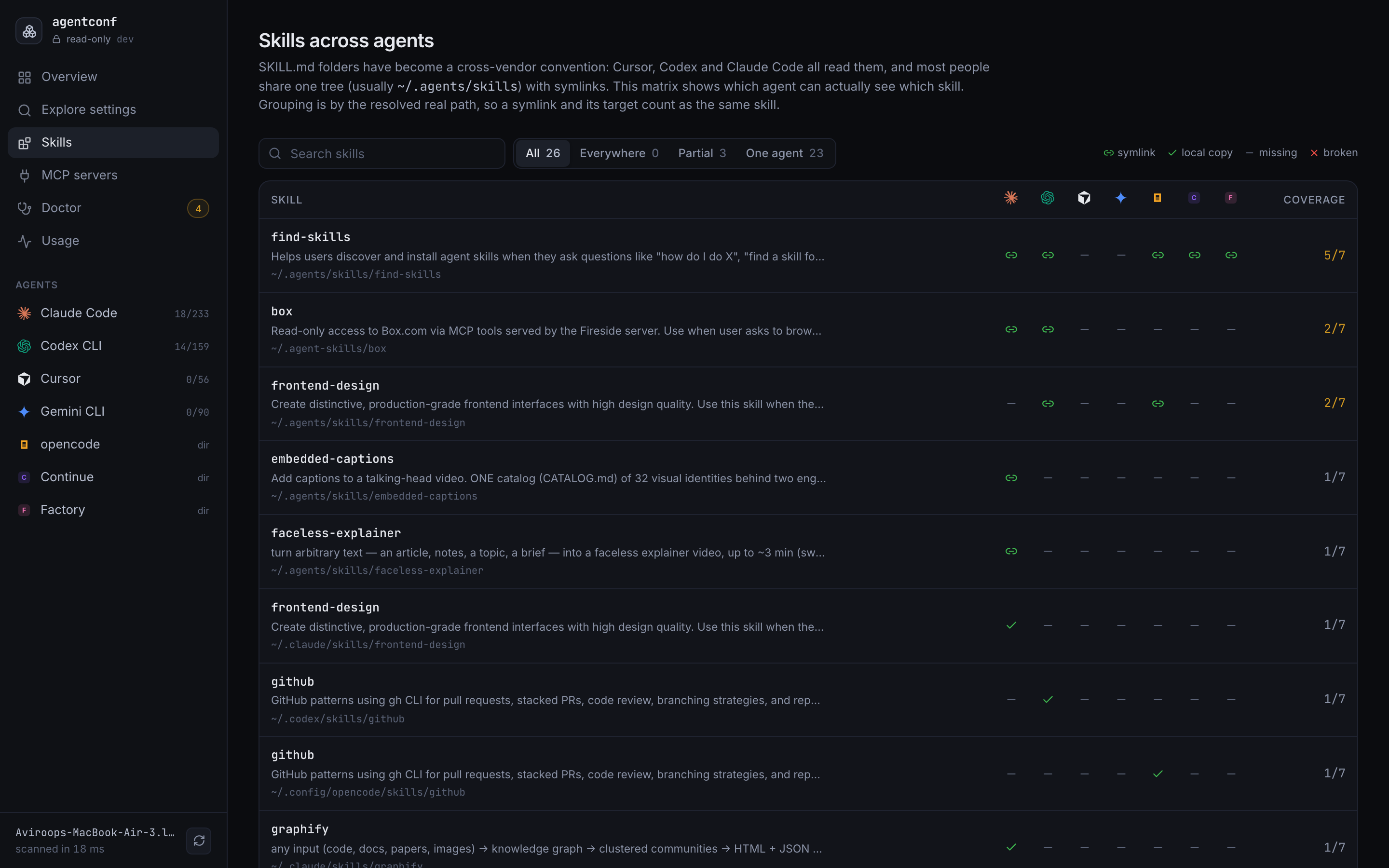
SKILL.md became a cross-vendor convention, and most people share one tree with symlinks. This matrix resolves every link to its real path and shows coverage per agent. Half-shared skills light up.

  • Symlink, local copy, missing, broken
  • Vendor-managed skills kept separate
  • Filter to everywhere, partial, or one agent
Skills coverage matrix across agents
MCP

One server list, four storage formats

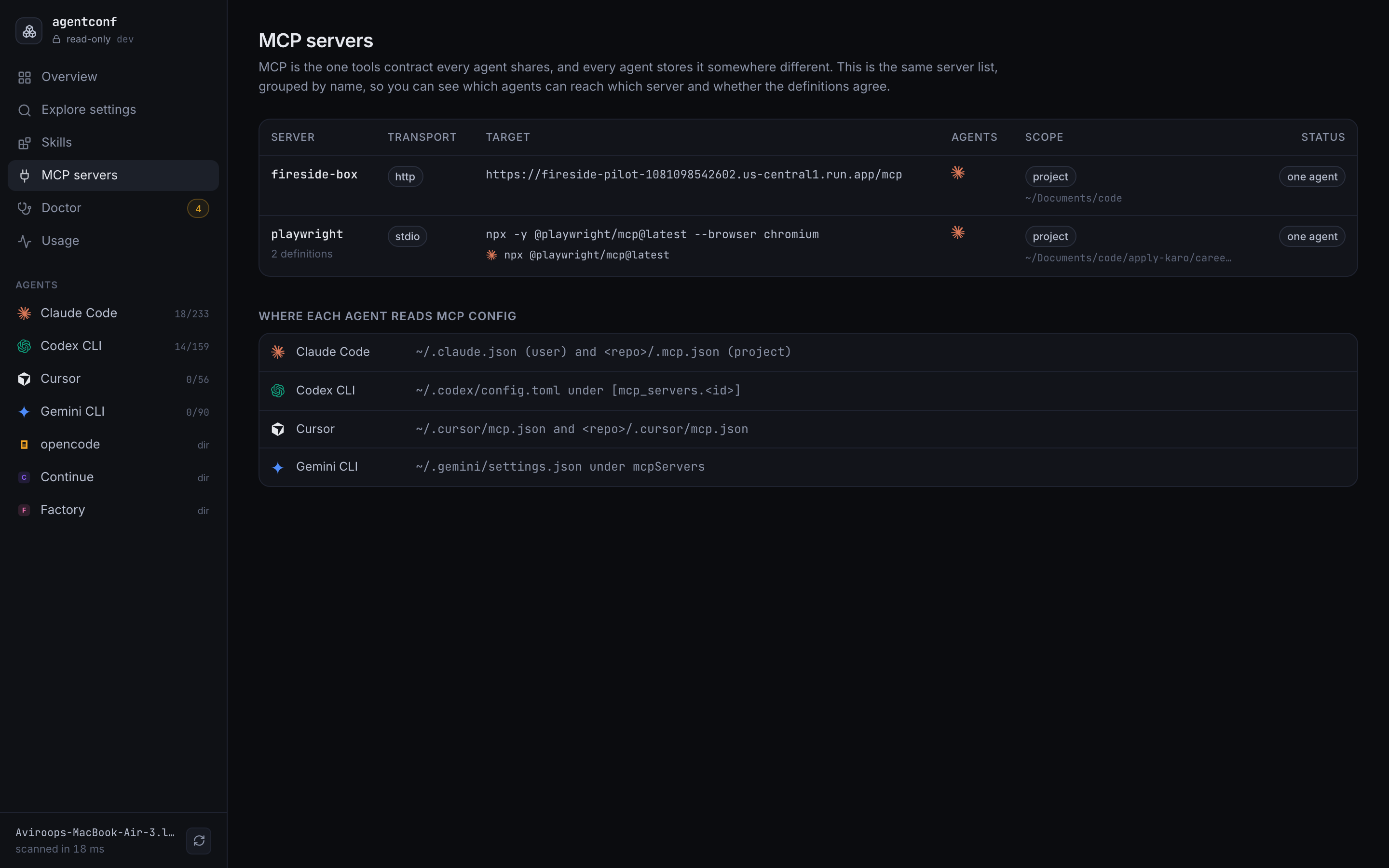
MCP is the one tools contract every agent shares, and every agent stores it differently. agentconf reads all of them and groups by name, so you can see which agents can reach a server and whether the definitions agree.

  • stdio and HTTP transports, user and project scope
  • Env and header values never read, only their names
  • Drift between agents flagged
MCP servers grouped by name across agents
Doctor

Diagnostics an editor cannot give you

Cross-agent drift, broken symlinks, deprecated keys still set, skills missing from some agents, keys the pack does not know, binaries that fail to run, state directories past a gigabyte. Every finding says what would resolve it. Nothing is changed for you.

  • Errors, warnings, notes, filterable by check
  • Also available as agentconf doctor in the terminal
  • Exit code 1 on errors, so it fits in a dotfiles CI
Doctor findings list
Usage

What each agent has accumulated

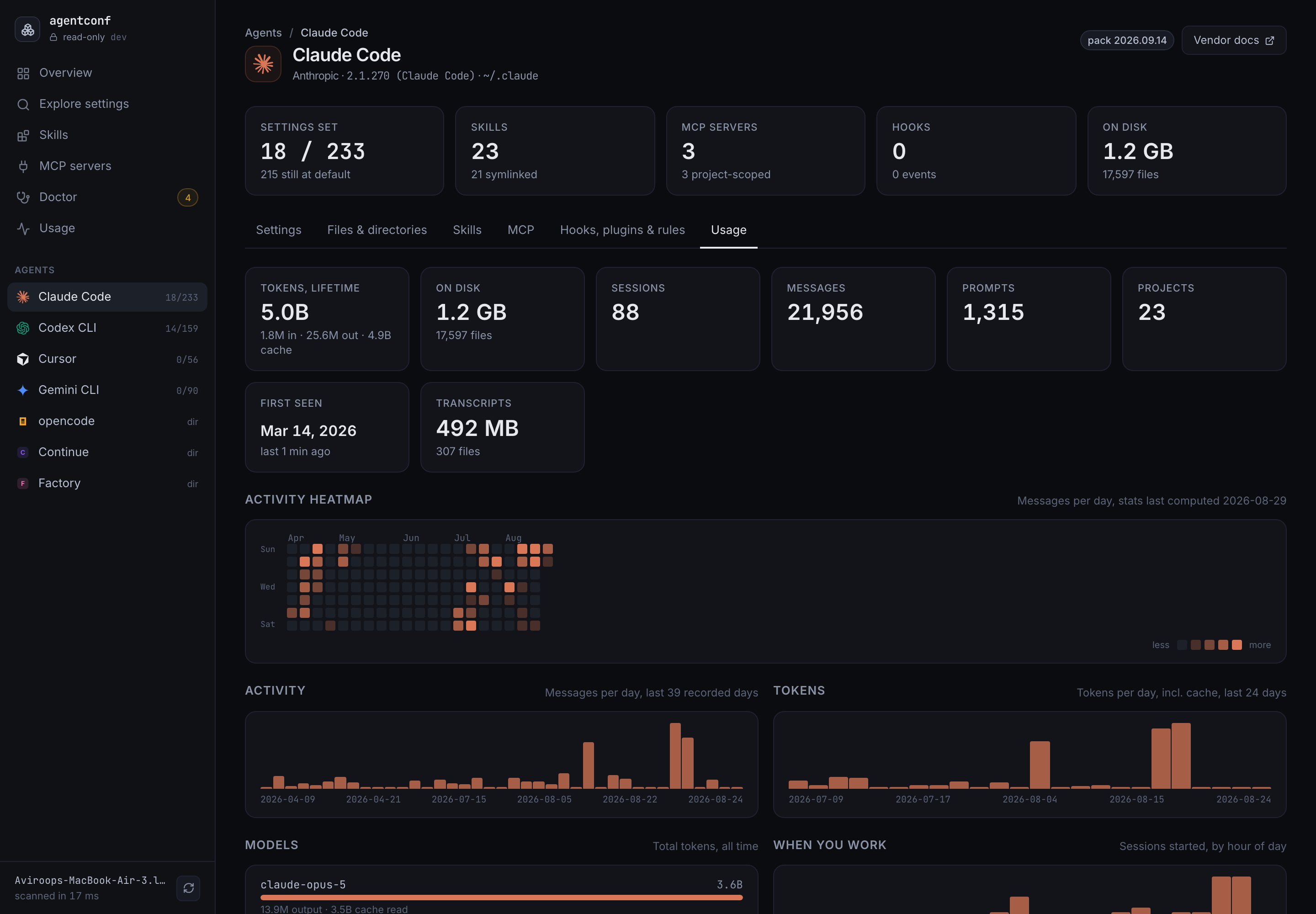
Sessions, prompts, messages, projects, disk. Claude Code's own stats cache gives per-model tokens, activity by day, and the hours you actually work. Counts and timestamps only. Prompt text is never read.

  • 1.2 GB of transcripts is a number worth knowing
  • First seen, last active, per agent
  • Notes explain exactly where each number comes from
Usage: activity by day, tokens by model, hours of day
Read-only by design

These folders hold your API tokens. The tool is built around that.

auth.json, oauth_creds.json, .credentials.json live next to the settings. agentconf treats that as the first design constraint, not an afterthought.

No write path exists

There are no write endpoints in the server and no write calls in the scanner. There is nothing to misclick and nothing to fat-finger.

Allowlist, not denylist

Only files the schema pack names are opened. Paths of kind credential are never read, not even to check their size.

Secrets masked before the UI

Values under headers, env, token, apiKey and friends are masked in the scanner. MCP env and header values are dropped entirely.

127.0.0.1 only

The server binds to loopback. No telemetry, no analytics, no update pings. Nothing leaves the machine.

Transcripts never read

Usage numbers come from counts, timestamps and the agents' own stats files. Prompt text and conversation content are not parsed.

7 MB, tens of milliseconds

One static Go binary. The first scan answers in about 30 ms; directory sizes and versions fill in behind it. Open it as often as you like.

Schema packs

The registry is the product. The binary is a viewer.

Each agent has one JSON pack: every key with its type, default, scope, summary, optional detail, flags and docs link. The UI renders whatever the pack describes. A tool with a hardcoded schema rots in months; a pack is a data file anyone can update, and the unknown-keys check tells you the moment it falls behind.

AgentKeysPathsSource of truth
Claude Code23363code.claude.com/docs/en/settings-reference
Codex CLI15931learn.chatgpt.com/docs/config-file/config-reference
Cursor5621cursor.com/docs/cli/reference/configuration
Gemini CLI9022geminicli.com/docs/reference/configuration

Adding an agent is adding a JSON file. Format: schemas/SCHEMA.md

Install

Ten seconds. One binary. No runtime.

macOS and Linux, arm64 and amd64. Windows via go install. The web UI is embedded in the binary; there is nothing else to fetch.

$ curl -fsSL https://raw.githubusercontent.com/AviroopPaul/agentconf/main/install.sh | sh
$ agentconf
agentconf v0.1.0
  http://127.0.0.1:4242
  read-only. press ctrl+c to stop.
Installs to ~/.local/bin. Override with AGENTCONF_INSTALL_DIR. The script is 60 lines; read it first if you like.
$ go install github.com/AviroopPaul/agentconf/app/cmd/agentconf@latest
$ agentconf
Needs Go 1.27 or newer. The built UI is committed to the repo so the embed works from a clean clone.
$ brew install AviroopPaul/tap/agentconf
$ agentconf
Tap is published by the release pipeline after the first tagged release.
$ git clone https://github.com/AviroopPaul/agentconf && cd agentconf
$ make          # builds the frontend, then bin/agentconf
$ ./bin/agentconf
Go 1.27+, Node 20+. make doctor and make scan run the CLI subcommands.
agentconf
Scan, serve the UI on localhost, open a browser.
agentconf doctor
Diagnostics in the terminal. Exit 1 on errors, so it runs in CI.
agentconf scan | jq
The whole inventory as JSON. Diff it, pipe it, snapshot it.